A Smarter Part-Time Employee Benefits Strategy

A Smarter Part-Time Employee Benefits Strategy
Part-time employees are a critical part of today’s workforce, yet many still lack access to benefits that are practical, clear, and easy to use. Employers want to provide part-time workers with valuable benefits, but doing so while managing cost and complexity is not always straightforward. As such, many approaches rely on extending full-time benefit structures to part-time employees, which can limit access and reduce overall impact.
The challenge is not offering more benefits—it is delivering the right resources in a way that creates a clear advantage for both employees and employers.
Why Part-Time Benefits Strategies Are Falling Short
More employees now work in flexible part-time roles, and how they evaluate whether to stay with an employer is evolving along with them. Benefits are becoming a meaningful part of overall compensation rather than simply an added perk. Yet many part-time employees still have limited access to practical support they can easily use.
As this shift continues, expectations become more consistent than many employers realize. This leaves employers in a difficult position. They are expected to do more, but do not always have the right resources available to meet those expectations. Many strategies respond by adding more programs and vendors. However, adding more programs alone does not improve engagement if employees do not clearly see or use the value. Instead, it creates more to manage, more to communicate, and more for employees to sort through.
The issue is not just how benefits are delivered. It is whether employers have something valuable to offer in the first place.
What Effective Part-Time Strategies Have in Common
The most effective part-time benefits strategies focus on accessibility, relevance, and simplicity. This gives employers a practical way to strengthen the employee experience without adding significant cost or complexity.
Rather than replicating full-time benefit packages, successful strategies focus on benefits employees can access consistently and use immediately.
- Health solutions remove barriers to care
Help employees find and use care more easily instead of delaying treatment or going without it. - Cost-saving programs deliver immediate value
Create visible savings in everyday areas where traditional coverage may not apply. - Everyday benefits feel familiar and accessible
Encourage participation by connecting employees with services they already recognize and trust. - Protection addresses real-life needs
Extend assistance into legal, financial, and personal areas beyond core coverage.
Each category serves a different purpose. Some help employees save money right away, while others build confidence and trust over time. Together, they create a more complete benefits experience.
When benefits are structured this way, employees are more likely to understand them, use them, and recognize their value. For employers, that translates into stronger engagement, improved retention, and a benefits strategy better aligned with today’s workforce.
The goal is not to offer more benefits. It is to offer benefits employees value, use, and remember when deciding where to work.
How Simplicity Improves the Employee Benefits Experience
Once the right benefits are in place, the impact extends beyond engagement. The approach becomes easier to manage, communicate, and sustain. Instead of continually adding new programs, employers can build around a consistent benefits structure that remains relevant as workforce needs evolve. This reduces the need to revisit and rebuild programs each year or introduce new vendors to address gaps. It also creates a more stable communication framework, making it easier to keep employees informed without constantly introducing new options.
Ultimately, benefits shift from something requiring constant adjustment to something capable of scaling and delivering lasting value across the workforce.
How Employers Are Rethinking Part-Time Employee Benefits
For many employers, rethinking their approach starts with changing how benefits are delivered to part-time employees. Instead of piecing together individual programs, employers are looking for a more complete solution employees can recognize, access, and use.
This is where a unified benefits platform can make a difference. New Benefits brings together high-demand, everyday benefits in one place, making it easier for employees to find and use the resources available to them.
Rather than managing multiple vendors or disconnected programs, employers can streamline delivery through a single, consistent experience. The result is a simpler way to provide relevant benefits across the workforce while reducing administrative complexity.
Building a more effective part-time employee benefits strategy starts with aligning benefits to the needs of today’s workforce. When employees see real value in what is offered, employers can strengthen engagement, improve retention, and create a meaningful competitive advantage.
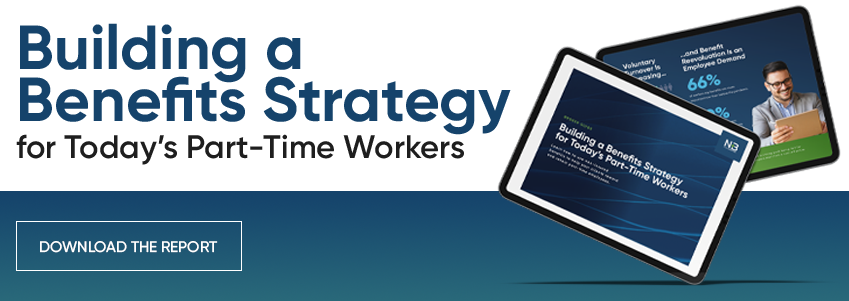
Download the Part-Time Benefits Guide to see how organizations are building more effective benefits strategies for part-time employees.